3 Ocak 2025 Cuma
2025 Memur Zam Oranı Ne oldu ?
2025 emekli maaş zam oranları hakkında şu an için netleşmiş bilgiler bulunmaktadır. Ancak, bu oranlar sürekli değişen ekonomik koşullar ve enflasyon verileri doğrultusunda güncellenebilir. İşte şu anki bilgilere göre 2025 emekli maaş zam oranları:
**Memur ve Memur Emeklileri:**
* 2025 yılının ilk altı ayında %11,54 oranında zam yapıldı.
* Bu zam oranına ek olarak, enflasyon farkı oluşması durumunda bu fark da maaşlara yansıtılacak.
**SSK ve Bağ-Kur Emeklileri:**
* SSK ve Bağ-Kur emeklileri için 2025 Ocak ayında %15,75 oranında zam yapılması bekleniyor.
* Bu oranın kök maaşlara uygulanacağı ve ardından %4 ek ödeme yapılacağı belirtiliyor.
**Önemli Notlar:**
* Bu zam oranları, açıklanan enflasyon verileri ve toplu sözleşme hükümleri doğrultusunda belirlenmiştir. Ancak, enflasyonun beklentilerin üzerinde gerçekleşmesi durumunda, memur ve memur emeklileri için enflasyon farkı zammı da uygulanabilir.
* Emekli maaş zamları genellikle kök maaş üzerinden hesaplanır. Bu nedenle, zam oranlarının maaşınıza ne kadar yansıyacağını hesaplamak için öncelikle kök maaşınızı bilmeniz önemlidir.
* 2025 yılı için emekli maaş zammı hesaplamaları ve olası senaryolar hakkında farklı kaynaklarda çeşitli bilgiler bulunmaktadır. Bu bilgileri karşılaştırarak ve güncel gelişmeleri takip ederek en doğru bilgiye ulaşabilirsiniz.
**Ek Bilgiler ve Kaynaklar:**
* Çeşitli haber siteleri ve finans portalları (örneğin, Bigpara, NTV, Gazete Oksijen) emekli maaş zamları hakkında güncel bilgiler ve hesaplamalar sunmaktadır. Bu kaynakları inceleyerek daha detaylı bilgi edinebilirsiniz.
* Sendikaların (örneğin, Türk Harb-İş Sendikası) yayınladığı raporlar ve açıklamalar da emekli maaş zamları konusunda önemli bilgiler içerebilir.
**Özetle:** 2025 yılı için emekli maaş zam oranları memurlar için %11,54, SSK ve Bağ-Kur emeklileri için ise %15,75 olarak belirlenmiştir. Ancak, bu oranların enflasyon ve diğer ekonomik faktörlere bağlı olarak değişebileceğini unutmamak önemlidir. En güncel ve doğru bilgi için güvenilir kaynakları takip etmeniz önerilir.

6 Mart 2011 Pazar
27 Şubat 2011 Pazar
Untangling the Puzzle of Risk Appetite
Untangling the Puzzle of Risk Appetite
When analyzing forex, nothing is more satisfying than establishing a strong correlation between a particular currency pair and another quantifiable investment vehicle. You see – we fundamental analysts love to kid ourselves that we can actually explain what’s going in the forex markets, but it’s only when you can visually observe (and statistically confirm) a correlation can you actually pretend that this self-assuredness is justified.
On that note, I found myself looking at in interesting chart today: the EUR/USD vs. CHF/USD vs. S&P 500 Index. My purpose in drawing this particular chart was to ascertain how risk appetite (represented by the S&P) is being reflected in forex markets. As you can see, two observations can immediately be made. CHF/USD very closely tracks the S&P (or vice versa), while the EUR/USD similarly mirrored the S&P for most of the last 12 months, before suddenly diverging in November 2010.

While this explains why the Euro should also appreciate for five consecutive months, it doesn’t offer any insight into why the EUR/USD correlation with the S&P should suddenly breakdown. [Question #2]. Recall from my earlier posts that there was a sudden flareup in the Eurozone sovereign debt crisis in November 2010. Around that time, there were a handful of debt downgrades, Ireland received an EU bailout, and there was heightened concern that the crisis would soon spread from Greece to the rest of the PIGS.
This caused a bout of intense Euro instability, against both the US Dollar and Swiss Franc. While the S&P continued rising, interest in emerging market stocks began to flag. It’s extremely tempting to posit a connection between these two trends, especially since it would seem to be implied by the chart. However, I think the correction in emerging markets is due more to Central Bank intervention and a recognition that a bubble was forming, than to the EU sovereign debt crisis. That the Euro has rallied in 2011 even as emerging market stocks have begun to decline, supports this interpretation.
Trying to draw meaningful conclusions from these correlations is frustrating at best, and dangerous at worst. Namely, that’s because it’s impossible to completely distinguish cause from effect. The two stock market indexes are probably the least dependent of the four items. For instance, the Euro is derived in part from the Dollar, which is derived in part from the S&P. You could say that the Franc takes its cues from the S&P (as a proxy for risk appetite) and the Euro. Second of all, the strongest correlation on the chart (CHF/USD and S&P) is also the most unexpected.
In the end, I think only one solid conclusion can be drawn: uncertainty surrounding the Euro will continue to boost the Franc. While I probably could have told you that without the use of this chart, at the very least, it reinforces the interconnectedness of all financial markets and that even if poorly understood, all trends are ultimately related.
When analyzing forex, nothing is more satisfying than establishing a strong correlation between a particular currency pair and another quantifiable investment vehicle. You see – we fundamental analysts love to kid ourselves that we can actually explain what’s going in the forex markets, but it’s only when you can visually observe (and statistically confirm) a correlation can you actually pretend that this self-assuredness is justified.
On that note, I found myself looking at in interesting chart today: the EUR/USD vs. CHF/USD vs. S&P 500 Index. My purpose in drawing this particular chart was to ascertain how risk appetite (represented by the S&P) is being reflected in forex markets. As you can see, two observations can immediately be made. CHF/USD very closely tracks the S&P (or vice versa), while the EUR/USD similarly mirrored the S&P for most of the last 12 months, before suddenly diverging in November 2010.
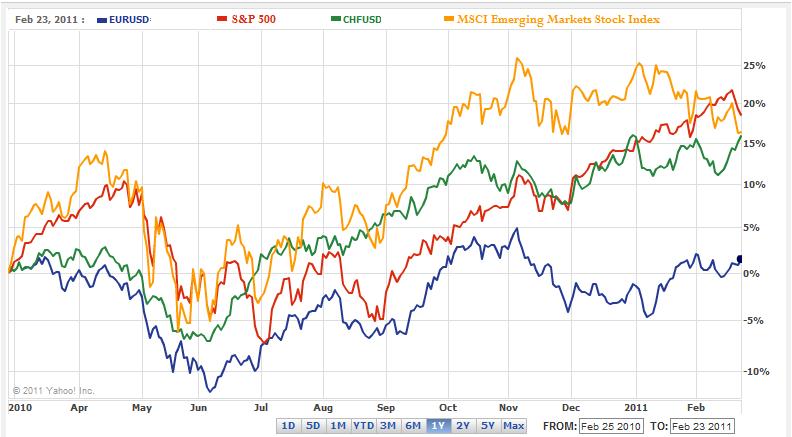
By extension, this raises two questions. First, why should a rising S&P be accompanied by the Swiss Franc? After all, the former is a proxy for risk appetite, while the latter is a symbol of risk aversion. That means that tither the S&P is a weak indicator of risk appetite, or the Swiss France is not being driven by risk aversion. In a way, I think both notions are true. Specifically, US equity prices are are primarily a sign of US economic recovery and strong corporate profits. It’s probably equally accurate to say that the S&P promotes risk appetite, as saying it reflects risk appetite.
Moreover, as US stocks and investor risk appetite have increased, interest in the US Dollar has (somewhat ironically) decreased. One would think that this would spur a depreciation in the Swiss Franc, but I guess this was superseded by the falling Dollar. [For that reason, I actually added the MSCI Emerging Markets Stock Index after I started writing this post, because I realized it was a better proxy for global investor risk appetite. Sure enough, the recent continuation in the Franc's rise has coincided with a correction in emerging market stocks].While this explains why the Euro should also appreciate for five consecutive months, it doesn’t offer any insight into why the EUR/USD correlation with the S&P should suddenly breakdown. [Question #2]. Recall from my earlier posts that there was a sudden flareup in the Eurozone sovereign debt crisis in November 2010. Around that time, there were a handful of debt downgrades, Ireland received an EU bailout, and there was heightened concern that the crisis would soon spread from Greece to the rest of the PIGS.
This caused a bout of intense Euro instability, against both the US Dollar and Swiss Franc. While the S&P continued rising, interest in emerging market stocks began to flag. It’s extremely tempting to posit a connection between these two trends, especially since it would seem to be implied by the chart. However, I think the correction in emerging markets is due more to Central Bank intervention and a recognition that a bubble was forming, than to the EU sovereign debt crisis. That the Euro has rallied in 2011 even as emerging market stocks have begun to decline, supports this interpretation.
Trying to draw meaningful conclusions from these correlations is frustrating at best, and dangerous at worst. Namely, that’s because it’s impossible to completely distinguish cause from effect. The two stock market indexes are probably the least dependent of the four items. For instance, the Euro is derived in part from the Dollar, which is derived in part from the S&P. You could say that the Franc takes its cues from the S&P (as a proxy for risk appetite) and the Euro. Second of all, the strongest correlation on the chart (CHF/USD and S&P) is also the most unexpected.
In the end, I think only one solid conclusion can be drawn: uncertainty surrounding the Euro will continue to boost the Franc. While I probably could have told you that without the use of this chart, at the very least, it reinforces the interconnectedness of all financial markets and that even if poorly understood, all trends are ultimately related.
Competition Heats Up in Retail Forex
Competition Heats Up in Retail Forex
The last few weeks have witnessed a number of major developments in the retail forex world: more mainstream firms entering the fold, and existing firms are moving to beef up their forex operations. Not only will this permanently alter the competitive landscape, but it should also benefit traders in the form of more choice, lower prices, and increased transparency.
The Wall Street Journal was first to report that Charles Schwab is in the early stages of introducing forex to the array of financial products available to its customer base: “Schwab, the largest online broker, disclosed in a slide presented at its recent winter business update that it was ‘analyzing the forex opportunity’ in 2011.” Unbeknownst to me, TD Ameritrade made a stealthy entry into forex in 2009, though its purchase of ThinkorSwim. Ameritrade offers more than 100 currency pairs (and its trading platform even has information on the Netherlands Guilder!), and currency and futures trading now accounts for 6% of its volume. E-Trade (which rounds out the “Big 3″ online discount brokers) currently enables customers to convert their unused account balances into five major currencies, but has yet to roll out a platform for trading currencies in real-time.
Some of the impetus is apparently coming from FXCM, which went public in 2010 and is aggressively marketing its trading platform to brokers which don’t specialize in forex. Given the surging volume and healthy spreads in forex, its probably not difficult to sell its appeal. Online brokers have also acknowledged that the majority of its profits are generated by a minority of its customers. Given that most currency traders tend towards being extremely active, it won’t be long before they are courted by traditional brokers.
What we are witnessing is a consolidation and mainstreaming of retail forex. In 2010, the US Commodity Future Trading Commission (CFTC) moved to bring retail forex out of the shadows and under its regulatory umbrella. New rules raised registered capital requirements, lowered leverage ratios, and generally increased the amount of scrutiny applied to brokers. This forced smaller players to either merge, move overseas, or quit the retail forex business. It also galvanized the major brokers, in the form of two Initial Public Offerings (IPOs), capital infusions, and a blitz of advertising. This week, CitiFX introduced a new forex pricing structure, major currency spreads to under 2 pips for its favored customers. TradeStation Forex also announced plans “to launch and offer exclusively the company’s new forex brokerage offering beginning later this quarter.”
In the next few years, I think we will witness further consolidation, with ~10 brokers accounting for the majority of retail forex trading volume. Online discount brokers may also establish themselves as a major force, luring customers through the strength of their brands and the accompanying guarantee of transparency, as well the ability to trade different types of securities using a single, integrated platform. Spreads will continue to fall for the major currencies, and even for some of the exotics. In fact, it probably won’t be long before retail forex becomes completely commoditized, and it loses its novelty.
The last few weeks have witnessed a number of major developments in the retail forex world: more mainstream firms entering the fold, and existing firms are moving to beef up their forex operations. Not only will this permanently alter the competitive landscape, but it should also benefit traders in the form of more choice, lower prices, and increased transparency.
The Wall Street Journal was first to report that Charles Schwab is in the early stages of introducing forex to the array of financial products available to its customer base: “Schwab, the largest online broker, disclosed in a slide presented at its recent winter business update that it was ‘analyzing the forex opportunity’ in 2011.” Unbeknownst to me, TD Ameritrade made a stealthy entry into forex in 2009, though its purchase of ThinkorSwim. Ameritrade offers more than 100 currency pairs (and its trading platform even has information on the Netherlands Guilder!), and currency and futures trading now accounts for 6% of its volume. E-Trade (which rounds out the “Big 3″ online discount brokers) currently enables customers to convert their unused account balances into five major currencies, but has yet to roll out a platform for trading currencies in real-time.
Some of the impetus is apparently coming from FXCM, which went public in 2010 and is aggressively marketing its trading platform to brokers which don’t specialize in forex. Given the surging volume and healthy spreads in forex, its probably not difficult to sell its appeal. Online brokers have also acknowledged that the majority of its profits are generated by a minority of its customers. Given that most currency traders tend towards being extremely active, it won’t be long before they are courted by traditional brokers.
What we are witnessing is a consolidation and mainstreaming of retail forex. In 2010, the US Commodity Future Trading Commission (CFTC) moved to bring retail forex out of the shadows and under its regulatory umbrella. New rules raised registered capital requirements, lowered leverage ratios, and generally increased the amount of scrutiny applied to brokers. This forced smaller players to either merge, move overseas, or quit the retail forex business. It also galvanized the major brokers, in the form of two Initial Public Offerings (IPOs), capital infusions, and a blitz of advertising. This week, CitiFX introduced a new forex pricing structure, major currency spreads to under 2 pips for its favored customers. TradeStation Forex also announced plans “to launch and offer exclusively the company’s new forex brokerage offering beginning later this quarter.”
In the next few years, I think we will witness further consolidation, with ~10 brokers accounting for the majority of retail forex trading volume. Online discount brokers may also establish themselves as a major force, luring customers through the strength of their brands and the accompanying guarantee of transparency, as well the ability to trade different types of securities using a single, integrated platform. Spreads will continue to fall for the major currencies, and even for some of the exotics. In fact, it probably won’t be long before retail forex becomes completely commoditized, and it loses its novelty.
Kaydol:
Kayıtlar (Atom)